
Key Stage 4: Physical Education Examination subjects
In Physical Education we offer learners OCR GCSE PE
Curriculum Intent
- GCSE (9–1) study in Physical Education should be broad, coherent and practical, encourage learners to be inspired, motivated and challenged by the subject and enable them to make informed decisions about further learning opportunities and career pathways.
- GCSE (9–1) specifications in Physical Education will equip learners with the knowledge, understanding, skills and values to develop and maintain their, performance in physical activities and understand the benefits to health, fitness and well-being. This will require them to:
- Develop theoretical knowledge and understanding of the factors that underpin physical activity and sport and use this knowledge to improve performance
- understand how the physiological and psychological state affects performance in physical activity and sport perform effectively in different physical activities by developing skills and techniques and selecting and using tactics, strategies and/ or compositional ideas
- develop their ability to analyse and evaluate to improve performance in physical activity and sport
- understand the contribution which physical activity and sport make to health, fitness and well-being
- understand key socio-cultural influences which can affect people’s involvement in physical activity and sport.
Theory Components
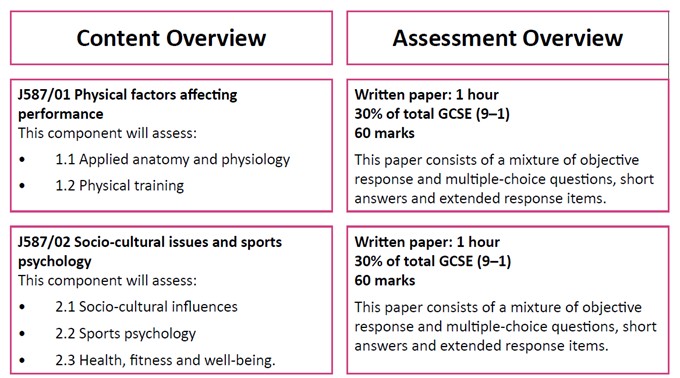
Component 01: Physical factors affecting Performance
- 1.1 Applied anatomy and physiology
- 1.2 Physical training
Component 02: Socio-cultural issues and sports psychology
- 2.1 Socio-cultural influences
- 2.2 Sports psychology
- 2.3 Health, fitness and well-being.
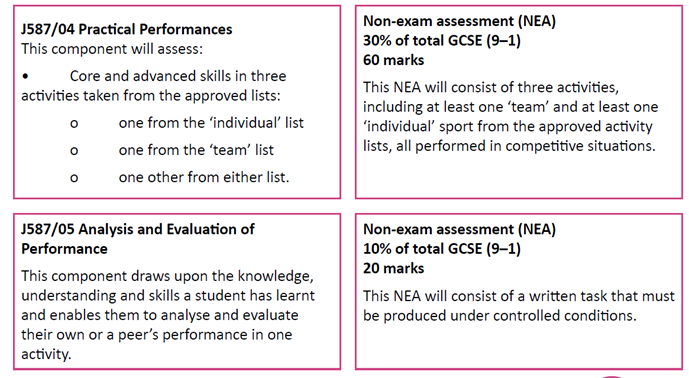
Component 04: Practical Performances (NEA)
Performance of three activities taken from the two approved lists.
- one from the ‘individual’ list
- one from the ‘team’ list
- one other from either list.
Component 05: Analysis and Evaluation of Performance (NEA)
- This component requires students to draw upon knowledge, understanding and skills learnt throughout their course of study. This will allow them to analyse and evaluate either their own or a peer’s performance in order to produce an action plan to improve the quality and effectiveness of the performance.
Extra-curricular activities
The department also run a number of educational trips that allow students to experience live professional sport. The department also run a biannual ski trip to Europe.